After an very rare yet very interesting Enlgish class I thought I'd share this little tidbit...
"Friend, on the scaffold Thomas More lies dead.
Who would not cut the Body from the Head."
This poem sounds as if someone asks a friend of Thomas More to cut his head from his body right?? Yeah, well that's what I thought when I walked into my classroom today and saw that poem scribbled on the blackboard. Our teacher made sure to keep up wondering until the last 20 minutes of class before he explained the history of such an odd sounding poem.
In the rein of King Henry VIII, after Henry's first wife Catherine could not bear a son, he asked the Catholic church to allow him to dissolve his marriage using "familial ties" as a reason. The Pope refused his request stating that records did not show any relation to his wife other than their marraige. Henry was angry, he wanted to Marry Ann Boleyn, who he hoped would bear him a son. So he created his own church called "The Church of England," a angelical church that he would be the head of, in turn being able to dissolve his marraige to Catherine. His new church was forced upon the people of England and they had to conform or they would be executed.
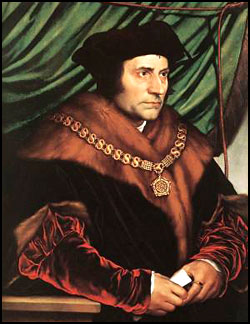
Thomas More was a member of Parliment and was close with King Henry. He was however a devout Catholic and would not endorse the dissolution of marriage to Catherine, nor would he convert to the Church of England. The meaning behind the above poem is:
Thomas More was executed for nonconformity to the Church of England
because he(More) wouldn't cut the Body (Christ or the Church) from the Head (The Pope).
Just an interesting little piece of religious history. Hope you enjoyed :)

3 comments:
Wow.. very interesting. :)
Maybe Ruth is right about those Religious poopheads out there - knocking someone off that was supposed to be your friend because of religious belief just isn't cool man!
I think the movie Dogma has it right in how it presents the idea of belief.
It proposes that beliefs are solid & unchangable. Ideas on the other hand can be changed. You can change an idea. Changing a belief is a little tricky.
Post a Comment